Massive Prague rally challenges Czech media funding reform
Up to 400,000 people gathered in Prague to oppose a government plan to replace public media fees with state budget funding, a move critics argue threatens broadcaster independence.
By News Media House Staff ·
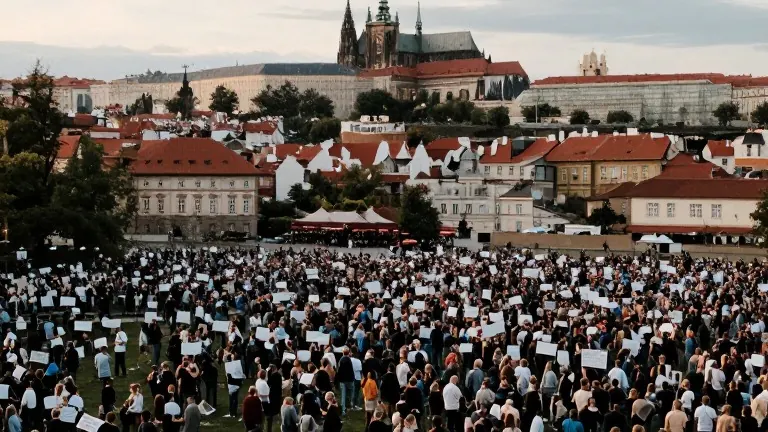
Hundreds of thousands of residents of the Czech Republic gathered in Prague on Sunday to demonstrate against a government proposal to overhaul public media financing. The protest marked a significant escalation in public opposition to the ruling coalition's plan to eliminate the mandatory household broadcasting fee and shift funding directly to the state budget. Organizers described the event as a major show of civic power, with estimates suggesting the turnout surpassed previous large-scale rallies in the capital.
Leaders of the demonstration stated that participation exceeded the numbers seen during a major anti-government protest in March, which drew more than 200,000 attendees. If final counts are confirmed, this Sunday's rally could stand as the largest public demonstration in the country since the Velvet Revolution of 1989. That historic event ended Communist rule and brought dissident playwright Vaclav Havel to the presidency.
Mikulas Minar, chairman of the civic organization Milion Chvilek, which coordinated the protest, estimated that approximately 400,000 people took to the streets. Minar argued that while elected governments have the authority to rule, they do not possess the unrestricted right to dismantle democratic institutions. He urged the ruling coalition to allow independent experts to propose genuine safeguards for media independence, rather than attempting to exert direct control over broadcasters.
The proposed legislation has drawn sharp criticism from opposition parties and civic groups who accuse the government of rushing the initial bill through parliament in the middle of the night in October. Critics have drawn comparisons to media reforms implemented in Hungary under former Prime Minister Viktor Orban, noting that such changes often lead to the establishment of pro-government media ecosystems. Many protesters are demanding that the ruling coalition rescind the law entirely.
The populist administration of Prime Minister Andrej Babis, supported by the far-right SPD and the eurosceptic Motorists parties, has frequently accused both private and public media outlets of bias. The draft bill aims to cancel a monthly 205-crown broadcasting fee, equivalent to roughly 9.26 dollars, which currently funds the sector. Although the bill has passed a preliminary vote, it still awaits further debate in the legislative process.
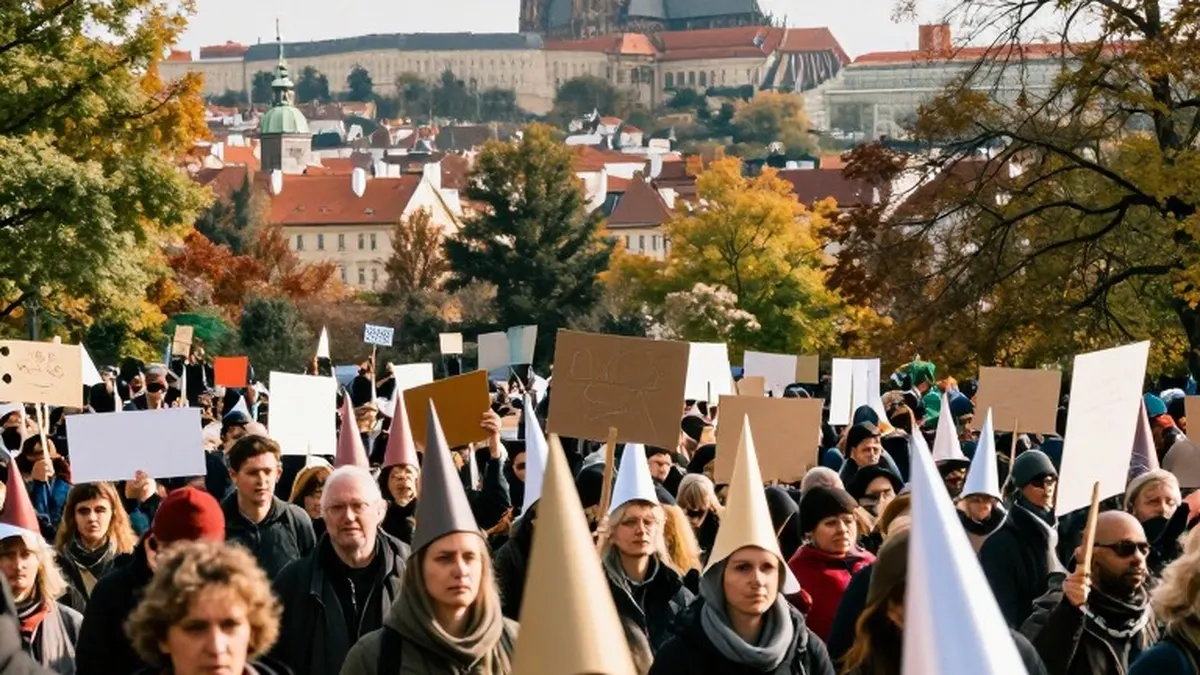
Protesters filled Letna Park, which overlooks the capital, and crowded nearby metro stations. Signs bearing slogans such as "Hands off the media" and "Let media deal with politicians" were visible throughout the crowd. The lineup of speakers included students, military personnel, and former dissidents associated with the Charter 77 initiative. The demonstration took place just days before November 17, a public holiday that commemorates the beginning of the Velvet Revolution.
In a symbolic gesture, many attendees wore pointed hats crafted from folded newspapers. This fashion choice paid tribute to a long-standing animated character who has introduced Czech Television's nightly children's stories for decades. The visual motif underscored the protesters' concern for the cultural and informational role of public broadcasting in their daily lives.
Milana Rudolfova, a 72-year-old pensioner present at the rally, expressed her confidence in the objectivity of Czech Television. She stated that without public television and radio, citizens would struggle to trust any source of information. Her comments reflected a broader sentiment among demonstrators who view the current funding model as a guarantee of truth in the media landscape.
The conflict between the government and media workers intensified earlier this month when public television and radio staff launched a one-day strike. The action resulted in broadcast curbs and was backed by protests from artists and students. Critics argue that moving funding to the state budget will weaken the direct relationship between broadcasters and paying viewers, making the sector more vulnerable to political pressure.
The financial implications of the proposed changes are also a point of contention. The plan includes a 15 percent cut to financing, which would reduce the nominal budget for television to 2008 levels and radio to 2005 levels. Media representatives describe these figures as unworkable. In response, Prime Minister Babis has maintained that the government is simply fulfilling a campaign promise to reduce the financial burden on households.
Originally published by News Media House