Starship caught by tower arms
SpaceX recovered its upper stage in a first-of-its-kind maneuver, though the first-stage booster failed and crashed into the Gulf of Mexico.
By Victoria Hayes ·
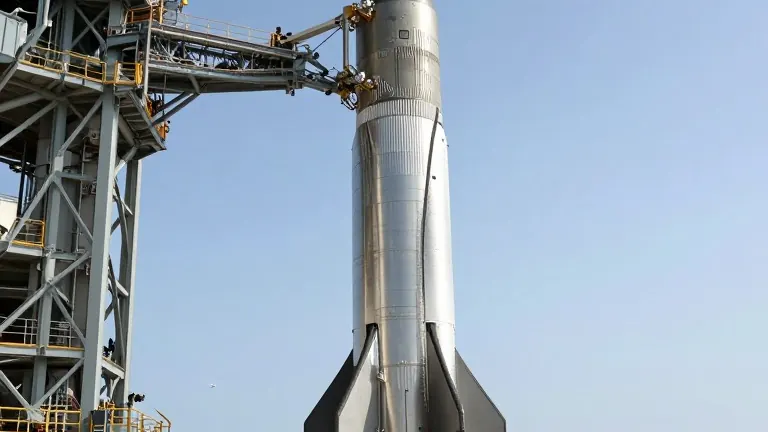
SpaceX’s Starship upper stage landed upright on Saturday at the company’s launch site in Texas.
Mechanical arms on the launch tower caught the spacecraft in midair. This marked the first time a Starship returned from orbit and was secured by these arms. The maneuver took place 22 hours after the rocket lifted off from the company’s base near the U.S.-Mexican border.
The first-stage booster, however, did not make it back to the pad. SpaceX engineer Kate Tice said the booster’s engines stopped firing too early during reentry. The guidance system detected the position error and triggered a self-destruction sequence. Debris fell into the Gulf of Mexico, where buoys now cordon off the area.
Despite the booster failure, the upper stage performed as planned. The 407-foot vehicle separated from its booster, entered orbit 165 miles above Earth, and released 26 Starlink satellites. It completed 14 laps around the globe before returning. SpaceX reported that the heat shield and other critical systems functioned correctly.
NASA Administrator Jared Isaacman praised the result on social media, calling the event "almost magic." The space agency is contracting Starship to deliver astronauts to the moon later this decade. SpaceX officials said the successful catch proves the full reusability of the upper stage, a key requirement for reducing costs in future missions.
This was the 15th flight of a full-scale Starship since 2023 and the second to reach orbit. SpaceX aims to begin launching Starships from Kennedy Space Center in Florida within the next few months. That facility will serve as the launch point for NASA’s next Artemis mission, which will remain in Earth orbit for lunar lander practice. Artemis III astronauts will later attempt to dock with both Starship and Blue Origin’s Blue Moon spacecraft.
NASA is targeting 2028 for Artemis IV, the first crewed moon landing since the Apollo era. The successful capture on Saturday demonstrates progress toward that goal, even as engineers investigate why the booster failed to return intact.