Federal Aviation Administration delays persist as thousands await new flight times
Secretary Duffy cites crew repositioning issues, while lawmakers debate whether new funding is necessary for aging air traffic control systems.
By Victoria Hayes ·
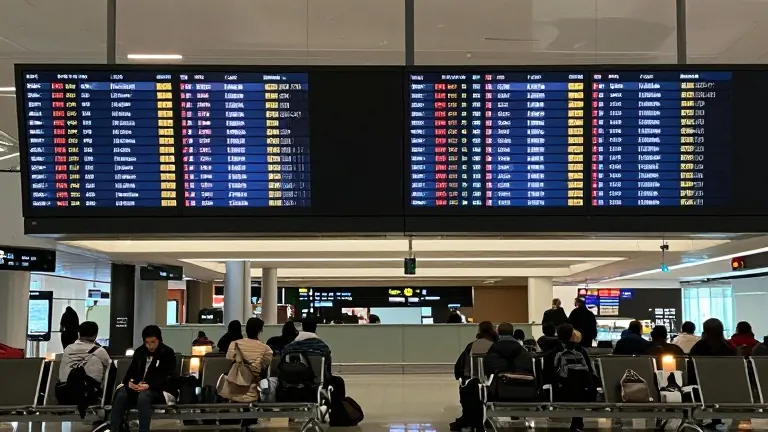
Nationwide flight delays continued into Sunday evening, leaving thousands of passengers in airports across the United States.
FlightAware.com reported that more than 2,300 flights were cancelled following the nationwide ground stop on Friday. An additional 8,000 flights involving U.S. airports were delayed as of Sunday night. Dallas-Fort Worth and Atlanta airports recorded the highest numbers of delays, with over 250 flights each affected.
The disruption stems from a failure in the Federal Aviation Administration's communications network. Transportation Secretary Sean Duffy attributed the issue to maintenance work performed by L3Harris Technologies Inc. The contractor was replacing old copper wire sections with fiber-optic cables. Duffy explained that the legacy equipment became overloaded, which disrupted communications. An initial investigation points to two locations as the source of the data flooding: a radar site in Amarillo, Texas, and a radio communications site in El Dorado, Arkansas.
L3Harris stated on Saturday that the company is working with the FAA to understand the conditions that led to the November 13 shutdown. The company noted that it has completed more than 70% of the planned airspace communications conversion from legacy copper to fiber optics.
Political discussions regarding funding for air traffic control have intensified since the incident. President Donald Trump called on Congress on Sunday to approve additional funding to update aging systems. He argued that the work should be done all at once rather than in small increments. Congress approved $12.5 billion for air traffic control safety upgrades in 2025. However, the administration requested $50 billion in emergency funding on Friday.
Secretary Duffy told NBC's Meet The Press that the system requires investment to ensure resilience. He stated that the administration believes the network has been neglected for decades. In contrast, two Democratic members of the House Transportation and Infrastructure Committee questioned the need for more money. Rep. Rick Larsen of Washington and Rep. André Carson of Indiana noted that while $12.5 billion was approved, only a portion has been utilized. They stated that the administration has obligated $4.3 billion of that amount but has only spent $1 billion. This leaves $8 billion unobligated and $11 billion unspent, they said.
Nick Daniels, president of the National Air Traffic Controllers Association, commented on the operational challenges faced by staff. He told NPR that the event demonstrated the capabilities of air traffic controllers when the national airspace system is shut down. Daniels emphasized that controllers worked with unreliable equipment to manage the situation. He said it is one of those moments that nobody can be prepared for or plan for.
Transportation Secretary Sean Duffy predicted a return to normal operations by the end of the day on Monday. He explained that aircraft and air crews are currently out of position due to the initial ground stop. Airlines require time to reposition these assets to resume regular schedules. Travelers at affected airports are waiting for updated departure times and rebooking information from their carriers.