Judge sets one-hour deadline for Trump arch vote
District Judge Tanya Chutkan ordered the government to notify her court within one hour if the National Capital Planning Commission approves the 250-foot structure.
By Daniela Ortega ·
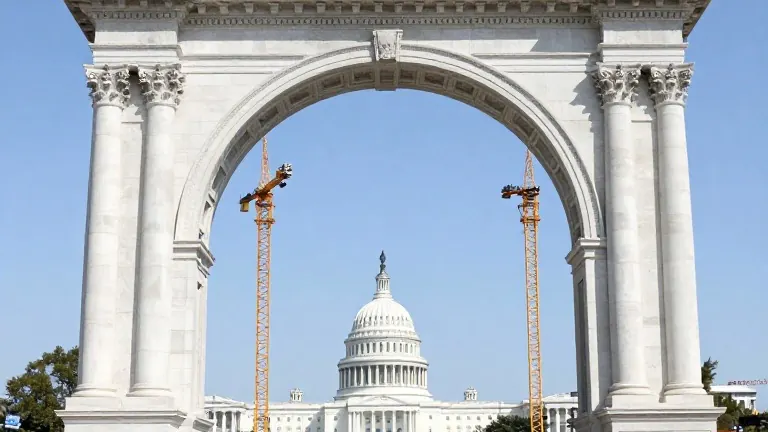
The Trump administration faces a critical deadline this week regarding a 250-foot triumphal arch planned for Washington, D.C. District Judge Tanya Chutkan ordered the government to notify her court within one hour of any decision by the National Capital Planning Commission. This ruling came as the commission prepares to vote on the final approval for the controversial structure.
The arch would stand on Memorial Circle, a traffic circle on the bridge connecting the National Mall to Arlington National Cemetery. The administration told the court late last month that construction could begin as early as Thursday, pending final approvals. The government plans to use Grunley Construction Company, a Maryland-based firm, for the project. The company may be arranging off-site preparations in anticipation of permit approval.
The structure is designed to be 250 feet tall, more than twice the height of the nearby Lincoln Memorial. Renderings show a white concrete structure topped with three golden statues, including a winged woman holding a torch. The Federal Aviation Administration stated in September that the arch would not pose an airspace hazard if it is continuously lit in a specific way. The administration recently described the arch as a military complex housing snipers and ammunition, a shift that legal experts say may be an attempt to frame it as a national security matter.
Critics argue the arch would obstruct important views and insult service members buried at Arlington National Cemetery. They also cite risks to the complex airspace over D.C. The White House has claimed the arch will enhance the visitor experience and become one of the world's most iconic landmarks. President Trump said from the Reflecting Pool on Monday that the arch would be one of the great things the country has ever done.
The legal challenge was brought by Vietnam War veterans and an architectural historian. They argue the arch is unlawful without approval from Congress. The administration has not sought that approval, instead citing a century-old authorization for a pair of columns on that traffic circle that were never built. Michael Lemmon, a veteran and retired foreign service officer who is a plaintiff in the case, said he hopes to be buried in Arlington National Cemetery but not in the shadow of what he believes is a personal vanity project.
D.C. and Virginia filed their own lawsuit over the weekend, calling the arch flagrantly illegal. Their 55-page complaint details how the project would disrupt local traffic, degrade the environment, and threaten security. The jurisdictions argue the arch violates federal environmental and historic preservation laws as well as local building height restrictions. They claim the project would substantially disrupt daily life in the capital region and complicate flight paths for Reagan Washington National Airport.
Judge Chutkan has consolidated the two cases. On Tuesday, the administration asked her to modify her order to require 24 hours of notice instead of one hour. The government explained that it takes time for decisions to be communicated through various chains of command. The plaintiffs opposed this request, comparing the situation to the East Potomac Park case, where the government had less than a day to notify the court before cutting down 430 trees. The judge later clarified her wording but kept the one-hour timeline.
The planning commission is expected to approve the arch. Its new chair, Mark Paoletta, expressed enthusiastic support for the project in an op-ed last month. The commission met over the summer to approve preliminary site and building plans. Nearly 120 citizens have signed up to speak at the Thursday meeting, an unusually high number that reflects widespread opposition. The meeting is scheduled to adjourn at 6 p.m. ET.
The administration says construction will take two to three years with crews working 20 hours a day. The first six months would involve underground excavation and foundation work. Lawyers for D.C. and Virginia argue the government would suffer no injury if required to wait. They wrote that the administration cannot claim an urgent need to begin building 101 years after the statute they cite was enacted. The final renderings sent to the commission do not mention drones or snipers, but Defense Secretary Pete Hegseth called the arch a generational national defense opportunity in a declaration submitted to the court.
Democratic lawmakers filed a supporting brief in the suit. Several vowed they will not let the arch proceed if their party retakes control of Congress. The legal battle continues as the commission prepares to vote. The government must now adhere to the strict notification timelines set by Judge Chutkan while the public participation session unfolds.