Eleven Paddlers Complete 310-Mile St. Johns River Journey in 29-Foot Canoe
The team traveled from Blue Cypress Lake to the Atlantic Ocean over four days, sleeping only once.
By Peter Graham ·
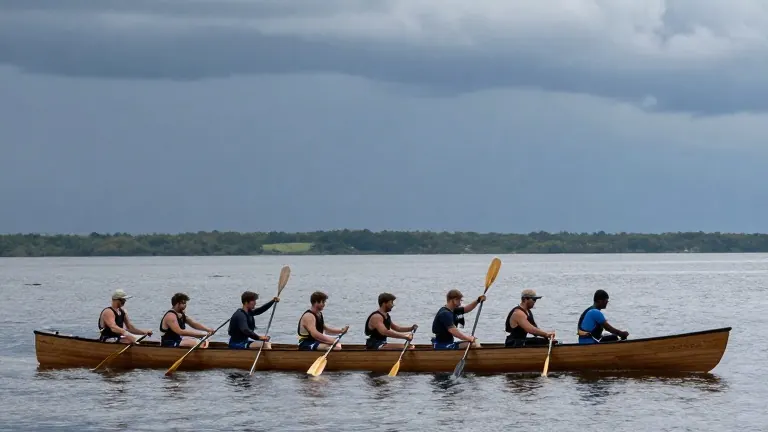
Eleven paddlers completed a 310-mile journey down the St. Johns River in just over four days, traveling from Blue Cypress Lake near Yeehaw Junction to the river’s mouth on the Atlantic Ocean near Jacksonville. The group stopped to sleep only once during the expedition, resting for six hours beneath a highway bridge on the second night.
The expedition began at 6 a.m. on Friday, Sept. 4, and concluded at approximately 10 p.m. on Monday, Sept. 7. The St. Johns is Florida’s longest river at approximately 310 miles. It serves as an east-central component of the Florida Wildlife Corridor, connecting wetlands, ranchlands, forests, and conservation lands from central Florida to near the Georgia border.
The team traveled in Peacemaker, a 29-foot Voyageur-style canoe. The vessel was loaned by StirringWaters, a Central Florida organization dedicated to creating inclusive aquatic experiences for people and families living with disabilities. For four days and four nights, the canoe served as the group’s primary shelter and transportation.
Paddlers took turns catching brief naps in the bottom of the canoe while others continued to paddle. The boat carried the team through darkness, heat, torrential rain, and powerful thunderstorms. A 12th team member operated a support vehicle, meeting the paddlers at designated points to provide fresh water, food, and other supplies. This support allowed the group to remain on the river for long stretches without interrupting their journey.
Maria Angelino, an Impact Campaign Intern at the Florida Wildlife Corridor Foundation and one of the paddlers, described the canoe as a unique living space. “That canoe became its own little ecosystem,” Angelino said. “Eleven people were living together in this boat for days. We were eating together, sleeping in the bottom of the canoe, singing, laughing, getting on each other’s nerves and then getting back to paddling.”
Mason Gravley, the Impact Campaigns Director at the Florida Wildlife Corridor Foundation, recalled a moment when a large riverboat carrying nearly 100 passengers pulled alongside the canoe. The riverboat began racing the paddlers toward a channel marker more than a mile away. The crew paddled with full effort and narrowly reached the marker first. The boat captain waved his hat and sounded the horn as the passengers cheered.
Zach Franco, Conservation Partnership Coordinator at Archbold Biological Station, noted the challenging weather conditions. “The storms were incredible but terrifying,” Franco said. “You could watch these enormous black storms popping with lighting coming across the landscape.. Then suddenly you were in them. We were completely exposed on the river, but we just kept moving.”
The journey took the group through protected public lands, conservation easements, wetlands, and working cattle ranches. The final stretch toward downtown Jacksonville presented new challenges as tides, wind, and heavy boat traffic increased. Franco said the last 10 miles were the most difficult part of the trip.
“The last stretch was a completely different river than what we had experienced upstream,” Franco said. “The tides and wind were working against us, there was significantly more boat traffic, and we were already exhausted, and night fell once again.”
The expedition was documented through photography, video, and GPS tracking. Previous trips by the group included a 242-mile paddle of the Suwannee River and a 110-mile paddle of the Peace River.