Hector Ríos’ Home Battery Helps Power Puerto Rico Grid
A network of 115,000 household batteries has prevented dozens of outages on the island.
By Victoria Hayes ·
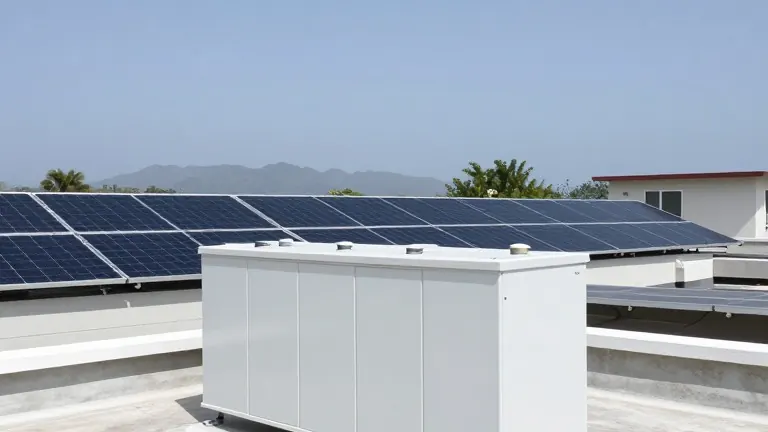
Hector Ríos, 75, watches energy leave his home in Cabo Rojo and support the wider grid. On nearly 20 days in October, the local utility pulled power from a battery attached to his house. This occurred on the southwest corner of Puerto Rico. Ríos accepts this arrangement because he receives payment for the energy. He views the trade as a fair contribution to the community while also earning income.
Ríos participates in a system known as a virtual power plant, or VPP. This network connects batteries from nearly 115,000 households to the main grid. The system activates when the island’s aging power plants cannot meet demand. Luma Energy, the transmission and distribution utility, reports that the VPP prevented or mitigated outages more than 60 times since June 1. The utility considers this one of the territory’s most effective tools for energy resilience.
Puerto Rico’s power infrastructure faces long-term challenges. Nine years after the public utility filed for bankruptcy, residents still encounter unpredictable blackouts. Electricity rates remain higher than in almost any state. Few new utility-scale power sources have been built since Hurricane Maria struck the archipelago in 2017. Most federal dollars promised for grid recovery have not yet reached the territory.
Javier Rúa Jovet, chief policy officer at the Solar and Energy Storage Association of Puerto Rico, describes the system as tangible. “There’s nothing virtual about it,” he said. “It’s real, and it’s better than a power plant.” The VPP is the first of its kind in Latin America and the Caribbean. It ranks as the second largest in the United States in terms of capacity.
The expansion of residential solar power followed Hurricane Maria. That storm left some communities without electricity for nearly a year. Experts linked the infrastructure failure to thousands of post-hurricane deaths. Rúa Jovet noted that the island had to procure resiliency differently. “We had to procure resiliency in some other way,” he said. “Not a centralized system that will completely fail for a whole year.”
There are now over 207,000 rooftop solar systems on the island. The population is fewer than 3.2 million people. This represents a 20-fold increase from before Maria. Most of these installations include at least one battery to keep systems running during blackouts. Ríos installed panels and a Tesla Powerwall battery in 2023. This system cut his summer utility bill in half, from about $400 to $200.
Luma launched the battery sharing pilot in late 2023. Ríos was among the first to enroll. Now, over half of solar customers participate in the program. When Luma predicts an energy deficit, it sends a digital notification to enrolled customers. Participants can opt out via an app or adjust how much battery capacity they share. Enrollees typically offer 30% of their stored energy.
The program has faced criticism. A 2026 survey by the nonprofit Solar United Neighbors found that some participants criticized the compensation structure. Others expressed hesitation to enroll because they did not understand the process or feared losing backup power. Ríos admitted he has experienced one issue where a storm knocked out power right after he shared his battery. He now skips sharing events if bad weather is forecast.
Ríos and his wife received $162 last year for their participation. They redeemed the amount as a Marshalls gift card. He described the payment system as a little vague. Luma pays solar providers three times the residential electricity price for the battery energy it takes. The utility recovers these costs through rate increases. Luma stated that relying on battery sharing has contributed in part to recent rate hikes.
Each battery sharing event typically lasts about four hours. This supports the equivalent of about 80,000 residential customers. Jigar Shah, director of the Department of Energy’s Loan Programs Office, suggested the batteries should function as a grid asset rather than just an emergency valve. He argued that dispatching power daily could offset the need to burn fossil fuels. Alejandro Figueroa, Luma’s chief regulatory officer, said a program used daily would require a different design and compensation structure to be sustainable. Puerto Rico aims to reach 100% renewable energy by 2050.
More Business · Orlando news · Buyer Beware · Report a business · Got a Story?