Orlando Utilities Commission Launches State's Largest Floating Solar Array
The 2-megawatt Conway Road installation utilizes stormwater ponds to generate power while preserving land for other uses.
By Peter Graham ·
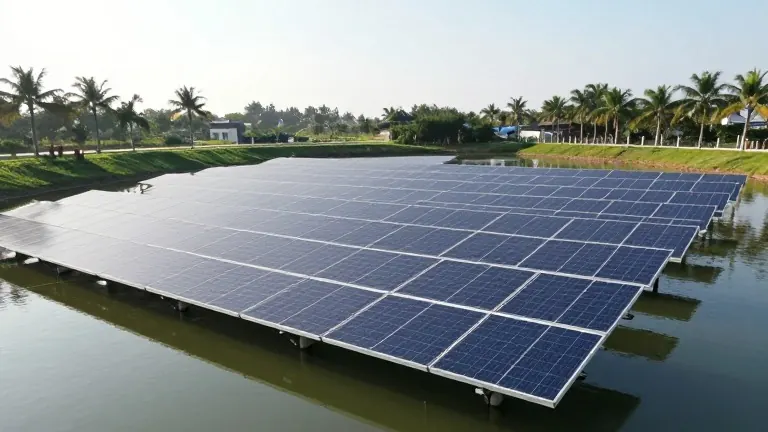
Orlando Utilities Commission activated its 2-megawatt Conway Road floating solar array in November 2025. The system comprises more than 3,400 panels mounted on buoyant structures. Commission officials identify it as the largest floating solar installation in Florida.
The technology places photovoltaic panels on the surface of existing water bodies. This approach allows utilities to generate electricity without consuming available land. The water beneath the panels provides a cooling effect that can increase energy output.
Floating solar technology has been under development for two decades. The median reported cost for these projects dropped from $2.41 per watt in 2015 to $1.25 per watt in 2024. Oktoviano Gandhi, a scientist at the Qatar Environment and Energy Research Institute, stated that lenders and investors have gained confidence in the reliability of the systems.
Florida’s physical characteristics make it a suitable location for this energy method. The state features heavy rainfall, flat terrain, and sandy soil. University of Florida researchers estimate that Florida towns and cities contain approximately 76,000 stormwater ponds. These ponds cover about 2.7% of the state's urban land area based on 2012 data.
State law enacted in 2022 explicitly supports the use of floating solar on these water bodies. Justin Kramer, director of emerging technologies and data analytics at the Orlando Utilities Commission, noted that available land within city limits is limited and expensive. He described the ponds as locations that were not being used for other purposes.
The commission began with a 32-kilowatt system and expanded that initial project. It later developed a separate 120-kilowatt installation. The new Conway Road array represents the most recent phase of this expansion. The panels are designed to adjust to changing pond levels and withstand local wind speeds.
Floating systems generally produce between 5% and 8% more power than typical rooftop arrays. Kramer attributed this increase to the cooling effect of the water. Gandhi cautioned that the magnitude of this benefit varies depending on wind conditions and ambient temperatures.
Florida operators have reported that these systems can withstand major weather events. D3Energy, which holds exclusive rights to develop floating solar on eligible Florida Department of Transportation stormwater ponds, operates more than 15 projects in the state. The company stated that none of its systems suffered structural damage during Hurricane Milton in 2024.
Scientists are currently studying the ecological impacts of covering water surfaces with panels. Rafael Almeida, an assistant professor at Indiana University Bloomington, said shading can alter photosynthesis and primary production in aquatic ecosystems. The University of Florida’s AJ Reisinger noted that stormwater ponds support algae, fish, birds, and bacteria that perform natural ecological processes.
The Orlando Utilities Commission limits panel coverage to 70% or 80% of a pond’s surface area. Kramer said the exact percentage depends on maintenance requirements and the specific ecosystem. Researchers do not yet know the precise tipping point where coverage begins to dramatically change the nature of the aquatic system.
More Business · Orlando news · Buyer Beware · Report a business · Got a Story?