Six Killed in Krakow Mass Shooting as Local Jewish Community Maintains Sense of Safety
Police opened a terrorism investigation after the suspect was found to hold extreme nationalist views, though witnesses and residents describe the violence as an isolated incident.
By Peter Graham ·
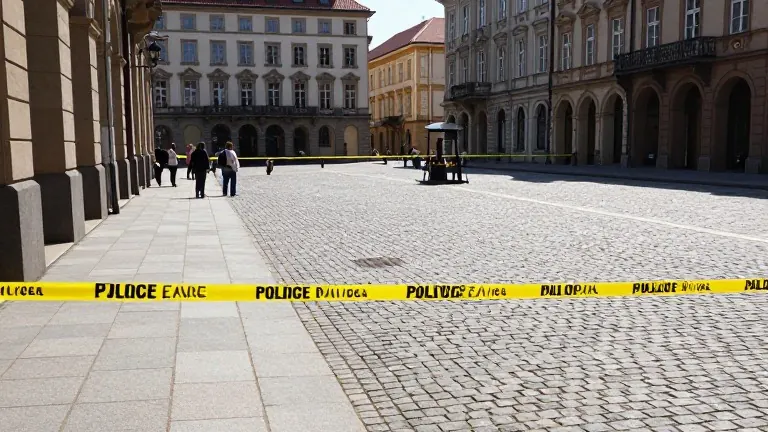
Six people died and 15 others were wounded in a mass shooting at Krakow's Old Town Main Square on Saturday. By Sunday, the scene remained cordoned off with police tape, and local officials had opened a terrorism investigation. The probe began after authorities revealed that the suspect held extreme nationalist views, though no links to specific extremist groups had been confirmed as of the morning after the attack.
The violence occurred in one of Europe's best-preserved historic Jewish neighborhoods. Approximately 10,000 Jews reside in Poland today, a fraction of the more than three million who lived there before the Holocaust. Lucy Les, who opened a Jewish bookstore in the Kazimierz Quarter in 1991 with her late husband, said the attack did not signal a rising tide of antisemitism. She noted that the city remains quiet and secure, adding that she was initially concerned the shooter might be Ukrainian, a detail that could have suggested an ideological motive. Instead, she described the suspect as a local individual with specific grievances.
Yarin, an Israeli man in his mid-20s who moved to the nearby city of Katowice two months ago for work, was standing 300 to 400 meters from the square when the gunfire started. He and others ran to a nearby restaurant, where they hid for more than two hours. Yarin said the experience was frightening, though less so for him than for those less familiar with regional conflicts. He observed that most people he spoke with viewed the shooting as a rare, one-time event rather than a systemic problem.
At Felafel Shelanu, a kosher restaurant in the Jewish Quarter, Oded and Hanna, a couple living between Jerusalem and Poland, echoed this sentiment. Oded, a Jerusalem resident, described the incident as something that happens once in 40 years. Hanna, who is studying in medical school in Katowice, said the people in Poland are kind, even as she missed her family in Israel. Her decision to study abroad was driven by the availability of a specific medical program not offered in her home country.
Tourist activity continued in the Kazimierz Quarter on a cold, sunny Sunday. Local guide Jakub Janeczko, who had been with a group of tourists in the square two minutes before the shooter reached their location, recounted how they fled into a building together. After sharing their experience with new visitors, Janeczko resumed his historical tour. He noted that while the city is recovering from the shock, daily life continues, and the closure of the Main Square has actually directed more visitors toward the Jewish Quarter.