UK proposes £4,000 credit per car for grid-export tech
A closed government consultation suggests carmakers could earn financial credits for installing vehicle-to-grid technology, a move critics say may ease pressure to sell electric vehicles.
By Peter Graham ·
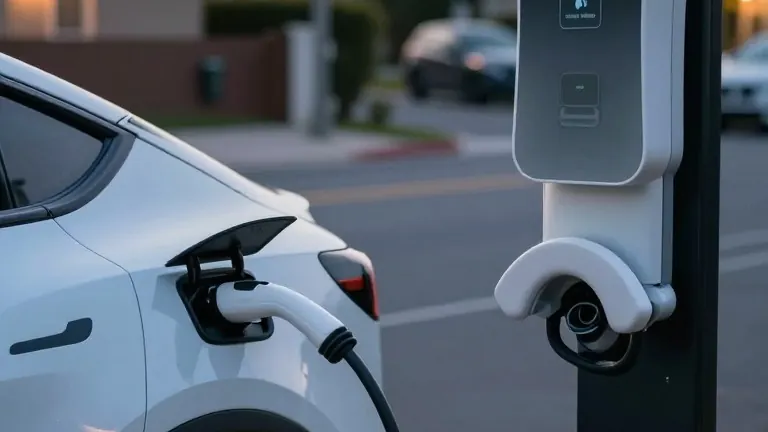
The United Kingdom government is weighing a proposal to grant carmakers a financial credit of approximately £4,000 for each electric vehicle equipped with vehicle-to-grid technology. The plan, detailed in a consultation that closed on Friday, aims to incentivize manufacturers to add bidirectional charging capabilities to their fleets. This feature allows cars to act as mobile battery storage, sending power back to the grid during periods of high demand.
The initiative is part of a broader review of the zero-emission vehicle mandate, which sets sales targets for electric cars. Under the proposed rules, manufacturers would receive a credit for selling cars with this specific technology. These credits would effectively allow companies to sell additional petrol-powered vehicles without facing penalties if they miss their mandated electric vehicle sales thresholds.
Vehicle-to-grid technology enables drivers to charge their cars automatically when electricity prices are low, typically overnight. The system then allows the vehicle to export some of that stored energy back to the grid when demand spikes and prices rise. This capability can also power a driver's home, a function known as vehicle-to-home. Proponents argue that if millions of cars adopt this technology, it could help balance the electrical grid during times when wind and solar generation is low due to weather conditions.
The government aims to reduce the reliance on expensive gas power plants to fill supply gaps. Smart charging tariffs, which encourage charging during cheap hours, already help manage the opposite problem of electricity overabundance. However, vehicle-to-grid offers a more direct method for vehicles to contribute to grid stability by exporting power rather than just consuming it.
Critics have raised concerns that the financial incentives could distort market behavior. Environmental groups worry that the credits might allow carmakers to delay the shift to electric vehicles by permitting the sale of more polluting petrol models. One analysis suggests that changes to the mandate could result in an additional 147 million tonnes of carbon emissions by 2050.
Ben Nelmes, chief executive of the thinktank New AutoMotive, described the technology as exciting but cautioned against rewarding manufacturers solely for installation. He noted that the proposed credits of around £4,000 per car far exceed the few hundred pounds in hardware costs. Nelmes argued that few drivers currently own the expensive chargers required to utilize the system, meaning shareholders may benefit more than end users.
Vicky Edmonds, chief executive of the Electric Vehicle Association England, stated that only a small fraction of the millions of electric vehicle drivers in the UK are currently using storage technologies. She described it as too early to grant credits for technology that has not been tested at scale in the real world. Edmonds emphasized that consumers are still focused on immediate concerns such as vehicle cost and daily usability.
Some drivers already participate in grid-export schemes through companies like Octopus Energy in the UK, Renault in France, and BMW in Germany. Octopus Energy claims its service allows drivers to save approximately £620 per year. The National Energy System Operator forecasts that if vehicle-to-grid technology scales, the collective output could reach 1.2 gigawatts by 2030. That figure could grow to 41 gigawatts by 2050, potentially meeting more than a quarter of peak energy demand.
The government has not yet finalized the rules following the consultation. The decision on how to integrate these credits into the zero-emission vehicle mandate will determine whether carmakers receive financial relief for adopting bidirectional charging or if the incentives remain tied to specific sales targets.
Source: The Guardian