Arab Nobel Laureates Counter HHS Secretary’s Remarks in Michigan
Robert F. Kennedy Jr.’s comments on Arab scientific output face scrutiny from multiple award recipients ahead of the midterm elections.
By Daniela Ortega ·
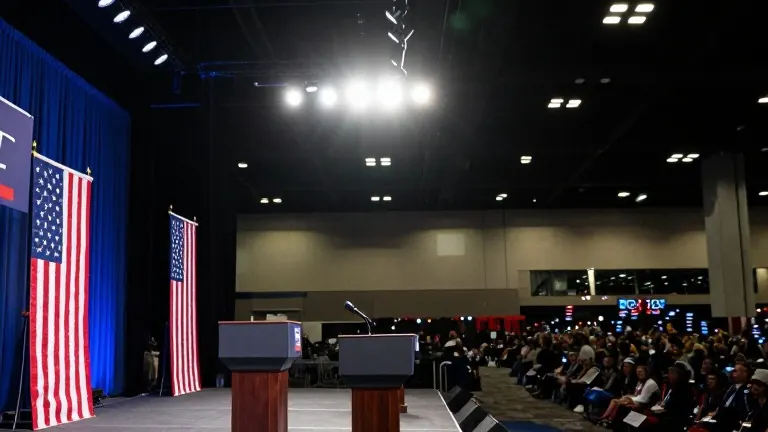
HHS Secretary Robert F. Kennedy Jr. claimed on Monday that the 500 million Arabs in the world do not produce science, a statement that drew immediate criticism from scholars and politicians.
Kennedy made the remarks while campaigning for Republican Senate candidate Mike Rogers in Grand Rapids, Michigan, a state with a substantial Arab American population. He argued that Arabs have not won the Nobel Prize, the Fields Prize, or the Wolf Prize, and do not produce literature. The comments came days before the midterm elections and were widely condemned overnight by critics who described them as racially biased and factually incorrect.
Several Arab scientists and writers have received major international awards in recent decades. Egyptian law scholar Mohamed El Baradei won the Nobel Peace Prize in 2005 with the International Atomic Energy Agency. In 2011, Yemeni activist Tawakkol Karman became the first Arab woman to win the Nobel Peace Prize. Egyptian American scientist Ahmed Zewail received the Nobel Prize in Chemistry in 1999 for his work on femtochemistry. Jordanian born chemist Omar M. Yaghi was one of three recipients of the 2025 Nobel Prize in Chemistry and won the 2018 Wolf Prize in Chemistry.
Other notable recipients include Egyptian writer Naguib Mahfouz, who won the Nobel Prize in Literature in 1988, and Sir Michael Atiyah, of Lebanese descent, who won the Fields Medal in 1966. Former Palestinian leader Yasser Arafat shared the 1994 Nobel Peace Prize with Israeli leaders Shimon Peres and Yitzhak Rabin. Former Egyptian President Anwar al-Sadat co-received the 1978 Nobel Peace Prize with Israeli Prime Minister Menachem Begin following the Camp David Accords.
Kennedy linked the lack of recent Arab scientific contribution to the influence of the Muslim Brotherhood, an Islamist organization founded in Egypt in 1928. He stated that the group destroyed traditional intellectual traditions and created stagnant societies. Rogers, who is campaigning against Democrat Abdul El-Sayed, has accused his opponent of having ties to the Muslim Brotherhood. El-Sayed, who has disavowed the group, also faces accusations from President Donald Trump regarding his connections to the organization.
Critics have pointed to specific historical and modern examples to refute Kennedy’s claims. Brad Woodhouse, president of Protect Our Care, called the comments possibly Kennedy’s ugliest episode yet. Dr. Peter Hotez, founding dean of the National School of Tropical Medicine at Baylor, noted on social media that his former colleague Zewail would have disagreed with the Secretary. Hotez also cited Arab scientists from the Middle Ages who preserved works by Aristotle, Hippocrates, and Galen for the Renaissance. An HHS representative did not immediately respond to a request for comment.
Kennedy is scheduled to speak at a rally in Des Moines, Iowa, on Wednesday. The Muslim Brotherhood was banned in Egypt in 2013 and designated a terrorist group by the United States, Saudi Arabia, the United Arab Emirates, and Bahrain in 2014. Jordan announced a sweeping ban on the organization last year.
Source: WKMG-TV · original report published
More Politics · Orlando news · Report a business · Got a Story?