69 Dead in Toledo Train Crash as Controller Error Cited
Spanish authorities attribute the collision to a mistake made during a safety system failure, while unions argue staffing shortages created the conditions for disaster.
By Victoria Hayes ·
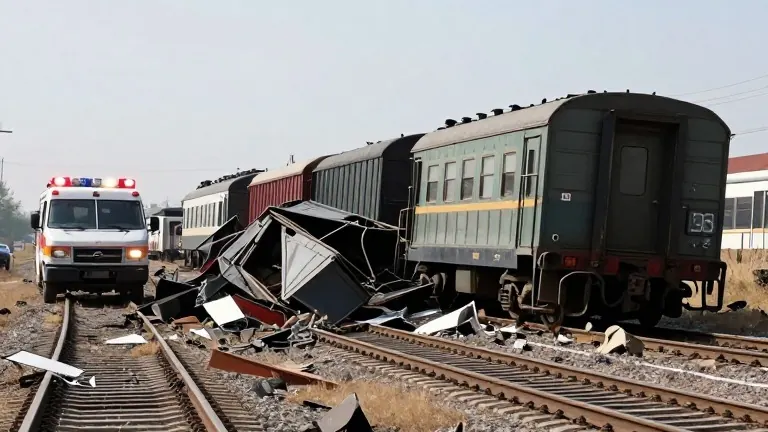
Sixty-nine people died in Toledo province on Wednesday when two trains collided near the town of Urda. The crash marks the second major disaster on Spain's Madrid-Seville high-speed line this year. Regional authorities stated that the death toll could still rise as police with sniffer dogs continued clearing the wreckage on Friday.
Transport Minister Óscar Puente assigned most of the blame to a traffic controller. He described the decision to allow one train to restart at full speed while the other remained stationary as erroneous. Puente told reporters that the information points to a mistake in the control center. He added that he would not use a worker as a shield for the failure.
The incident began at 8:31 a.m. on Wednesday when the LZB digital monitoring system went offline. This system uses sensors to track train positions and apply brakes automatically. With the backup system unable to assist because both trains were between analog sensors, human controllers took over supervision. At 8:36, a controller cleared a state-owned RENFE train to run at normal speed. A privately owned IRYO train, located 25 kilometers down the line, attempted to restart but failed. The IRYO engineer reported the problem, but the RENFE train was not ordered to stop. The collision occurred at 8:53 a.m.
Independent investigators reported that the RENFE train was moving between 100 and 125 mph at the time of impact. Rail unions challenged the minister's focus on individual error. Raquel Ayllón, spokesperson for the SCF union, stated that human error is not incomprehensible, but the regular failure of the safety system is. She noted that controllers work under increasingly poor conditions with heavy workloads.
Traffic on Spain's high-speed rail increased from 35 million passengers in 2019 to 49 million in 2024. Both of this year's collisions involved one RENFE train and one IRYO train. Union representative Joan Rodríguez argued that the liberalization of rail service was not matched by necessary line upkeep. Puente responded that his ministry increased controller staff from 1,000 in 2016 to 1,700 today.
The LZB system has been in use for three decades and is being phased out. It went offline 170 times this year due to infrastructure damage, maintenance, and weather. Train engineers union spokesperson Diego Martín said the system should have been replaced earlier. Puente acknowledged the frequent outages but called them normal within recent averages.
Special investigators removed the trains' black boxes late Thursday for inspection by the Civil Guard. A judge is conducting a parallel investigation. Only five of the 69 victims have been identified so far. Thirty-nine people remained hospitalized on Friday from the more than 200 injured. Seventy families filed missing persons reports for unaccounted passengers.
Source: La Voz de Houston