Israeli Vote Ends in Deadlock as Coalition Talks Set to Begin
Exit polls show Netanyahu's bloc and Eisenkot's party each taking about 51 seats, leaving Arab-led factions with potential kingmaker power.
By Peter Graham ·

Israel's election produced no clear winner on Wednesday, with exit polls showing Prime Minister Benjamin Netanyahu's right-wing bloc and challenger Gadi Eisenkot's Yashar party each capturing about 51 seats in the 120-seat Knesset. Arab-led factions were projected to win roughly 18 seats, positioning them to decide who forms the next government.
With 50% of votes counted by Israel's Central Elections Committee, Netanyahu's Likud party stood at 20.6% and Eisenkot's Yashar at 16.8%. The committee's tally does not yet indicate seat allocations. Final results, including hundreds of thousands of absentee ballots, are expected in the coming days.
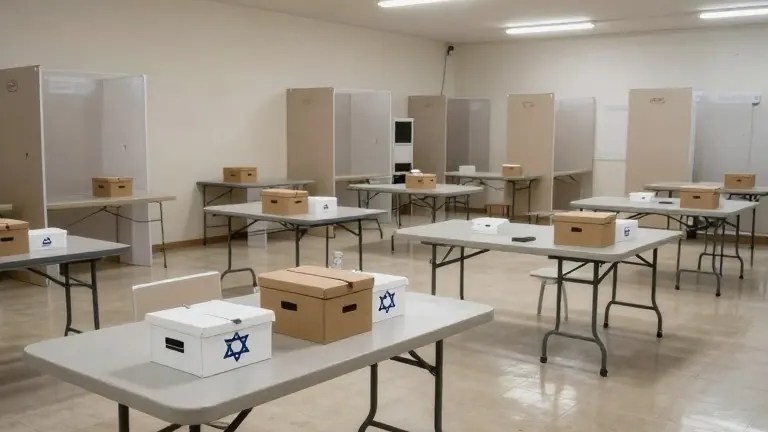
Voter turnout reached 77.7%, the highest level since 1999. The surge in participation accompanied a rebuke of Netanyahu's far-right coalition partners, including national security minister Itamar Ben-Gvir, who lost support among voters.
Netanyahu spoke early Wednesday, praising Israel's military operations over the past three years. He rejected any partnership with Arab parties, whose constituents make up 20% of Israel's population, calling such an arrangement unacceptable. "We must establish a strong, right-wing, nationalist government," he said. "We must not endanger Israel and establish a government that relies on anti-Zionist Arab parties."
Eisenkot addressed supporters in a speech focused on national unity, pledging to build a government. He has left open the possibility of working with Arab-led parties under conditions that include recognizing Israel as a Jewish state and Hamas as an extremist group. Some potential partners have already ruled that out.
United Arab List leader Mansour Abbas celebrated at his party's headquarters. "We are here, we are not on the sidelines," Abbas said. The United Arab List was the only Arab party to ever join a governing coalition, a brief arrangement in 2021.
Israel's president, Isaac Herzog, will ask a party leader to attempt to form a government, though he is not bound to select the party with the most seats. If no majority coalition materializes, new elections could be held early next year. Israel cycled through five elections between April 2019 and November 2022 during a similar stalemate. No single party has ever won an outright majority in the Knesset.
Source: WKMG-TV · original report published
More World · Orlando news · Report a business · Got a Story?