NASA's 1.5-ton Swift telescope expected to burn up Friday
A failed robot rescue left the observatory falling out of orbit, with debris predicted to hit the ocean or land in the Southern Hemisphere.
By Eric Collins ·
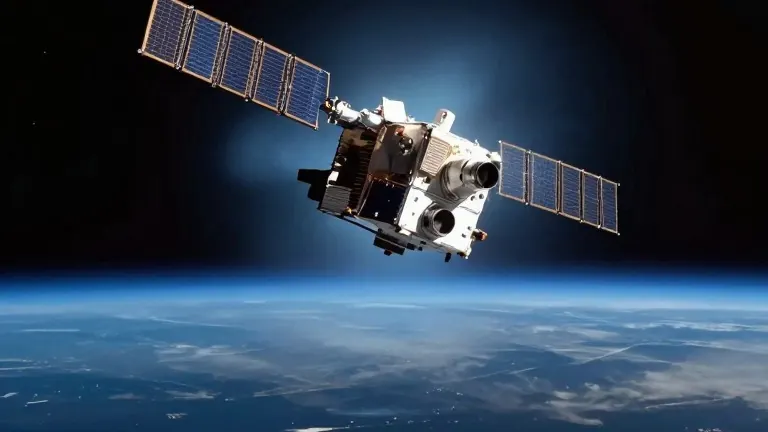
The Swift Observatory, a 1.5-ton NASA telescope, is expected to reenter Earth's atmosphere on or around Friday, Oct. 31.
The U.S. Space Force is tracking the spacecraft's declining path after a rescue attempt failed to stabilize its orbit. Most of the telescope will burn up during descent, but NASA's Brad Cenko, the mission's chief scientist, said some dense tungsten components and mirror parts may survive the heat of reentry. Cenko noted that any surviving wreckage is likely to land in the ocean, though the reentry zone covers parts of Africa, Australia, India, Southeast Asia, and Central and South America.
The spacecraft's orbit decayed faster than expected due to intense solar activity in recent years. To save the telescope, NASA hired Katalyst Space a year ago. The company launched a three-armed robot named Link in July. However, Link encountered technical issues and never got closer than 7 to 9 miles, or 12 to 15 kilometers, to Swift. The robot crashed back to Earth in September.
After the rescue was called off, Swift resumed taking data for a short period. It recorded additional gamma ray bursts and other high-energy events. By late October, the telescope dropped too low to maintain a steady position for observations, so engineers shut down its systems.
Swift launched on Nov. 20, 2004, from Cape Canaveral. Over 22 years in orbit, it detected more than 2,000 gamma ray bursts and 1,400 exploding stars. It also tracked comets, asteroids, and black holes that shred stars. John Nousek, an astronomer at Pennsylvania State University who led the control team, said the team has known this end was coming since before launch. He described the end as catastrophic but expressed gratitude for the data collected.
The telescope served as a rapid alert system for larger observatories like Hubble and Webb. Those larger scopes would use Swift's alerts to point at new events and gather deeper data. Scientists are now working on how to fill the gap left by Swift's retirement. Nousek said in an email that the team hopes lessons from Swift's success will help accelerate discoveries in future space missions.
Source: WKMG-TV · original report published