Arizona Canal Faces 47% Water Cut
Federal proposals threaten the Central Arizona Project, a system whose 1960s designers warned of future shortages that were largely ignored.
By Peter Graham ·
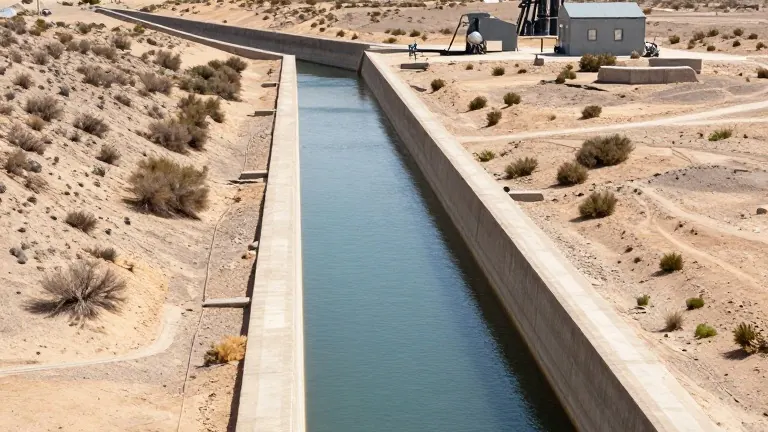
The Central Arizona Project, a 336-mile system of canals, pipelines, and pumping plants, faces a proposed 47% reduction in its annual water allocation. This federal plan triggered legal action this fall from Nevada, Arizona, and the canal system itself, which delivers Colorado River water to the Phoenix and Tucson areas. The cuts stem from the river’s record-low reservoir levels and an inability among policymakers to reach a regionwide agreement on demand management.
The canal system was authorized by President Lyndon B. Johnson in the 1960s as a solution for Arizona’s growing water needs. Floyd Dominy, then commissioner of the Bureau of Reclamation, publicly estimated that available supplies for the project would decline by more than half between 1990 and 2030. He attributed this forecast to increasing water use in upstream states, including Colorado, New Mexico, Utah, and Wyoming. Despite these specific warnings, the designers of the project did not anticipate that climate change and drought would become the primary drivers of the current crisis.
In 1968, Arizona Congressman Mo Udall testified before Congress that the project required additional water sources to remain viable. He argued that assuming no extra water would enter the river was a violent assumption. The original legislation included a ten-year moratorium preventing the federal government from studying water transfers from the Columbia River system in the Pacific Northwest. Senators from that region insisted on this clause to protect their own water supplies. Udall and other proponents also considered massive desalination facilities on the Pacific Coast as a potential backup.
Tom McCann, a former deputy general manager for the Central Arizona Project, stated that the 1960s warnings were largely forgotten for decades. He explained that there was no political willingness to spend money on a future problem that had not yet materialized. McCann said managers continued to study augmentation options, but cost and political hurdles prevented implementation. The project has operated without a major infusion of desalinated water or a pipeline from the Pacific Northwest since its inception.
Brad Udall, son of Mo Udall and a senior water and climate research scientist at Colorado State University, believes his father and uncle Stewart Udall, who served as Interior Secretary from 1961 to 1969, could have proposed better solutions. He described their suggestion of complex augmentation as a way to secure approval for the massive project during a period of national optimism. Udall noted that the mid-1960s mindset favored engineering solutions to every crisis. He said proponents likely wanted to finalize the canal quickly after a lengthy legal battle with California, hoping to address the water gaps later.
Chuck Podolak, former director of the Water Infrastructure Finance Authority of Arizona, suggests the promise of augmentation allowed policymakers to avoid a difficult political conversation. Farms and ranches account for roughly three-quarters of all Colorado River water use. Podolak argued that buying water from agricultural users would be more affordable than building new infrastructure. However, promising external water sources allowed officials to defer the reallocation of water from farms to cities, which would have required significant political negotiation.
The current federal plan aims to address the deficit by reducing Arizona’s take from the river. The Central Arizona Project remains critical to the region, with operators describing it as an engineering marvel that provides a stable water source for municipalities and industry. Rich Weissinger, who spent nearly 30 years working for the organization and served as director of field maintenance, noted that the system’s moving parts are robust. He emphasized that the project’s purpose is to deliver a reliable supply to the communities that depend on it.
Source: Central Florida Public Media · original report published