Filipino families gather at Manila graves for All Saints' Day
Thousands visited cemeteries across Manila on Sunday for Undas, a tradition combining Catholic observances with pre-colonial ancestor customs.
By Eric Collins ·
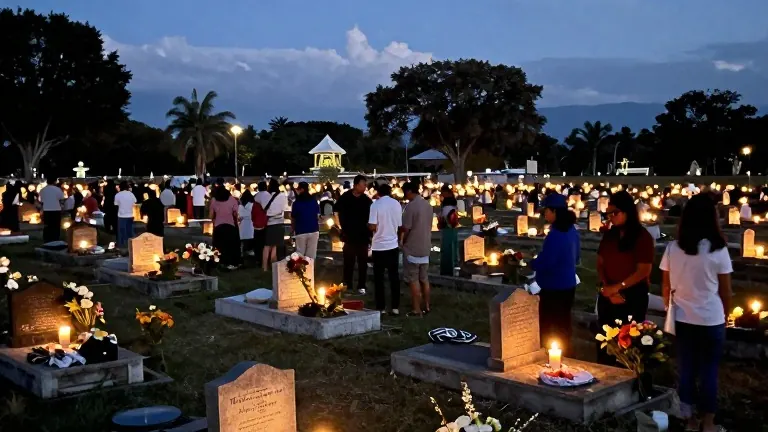
Manila's cemeteries drew thousands of Filipinos on Sunday as families marked All Saints' Day, laying flowers and candles at graves for a tradition known locally as Undas. The observance covers All Saints' Day and All Souls' Day on Nov. 1 and 2. The name comes from the Spanish word "honras," meaning "honors."
Lorita Santos visited the resting places of her father and three other relatives. Her family offers flowers and candles, prays together and shares snacks during the visits. Santos also uses the gathering to tell stories about relatives who have died, including how her father gave small gifts to his children and grandchildren every payday. "We will never forget that," she said. Santos grew up visiting relatives' graves even outside All Saints' Day, and she is now teaching her children to do the same. "We pass this on to our children to make sure they are aware of the tradition, so that if something happens to us, they know what to do," Santos said.
Mike Mamaril, a 42-year-old school maintenance employee, said visiting his parents' graves is a custom passed down from his grandparents. He makes time for the annual visit even though he rarely has another chance to go. The gatherings also give families a chance to recall lighter moments from childhood, he said. "We always talk about who among us got scolded the most," Mamaril said.
Nestor Castro, an anthropology lecturer at the University of the Philippines Diliman, said ancestor worship has a long history in the Philippines. Long before the Spanish arrived, Filipinos honored ancestral spirits known as anito by offering food and other gifts to the dead. These practices were not tied to a specific date. Castro said the tradition evolved after the Spanish arrived in 1565 and introduced Catholicism and related practices, some of which may have come from Mexico. The two countries were connected for centuries through the Manila-Acapulco galleon trade during Spanish colonial rule. Similar customs for honoring the dead are found in Mexico, Bolivia, Poland and Hungary.
Castro said family gatherings during funeral wakes and Undas serve a social function. Families wait for relatives who live far away to arrive before burying a loved one, and sticky rice cakes are shared at Undas to represent bonds between relatives. "These events foster and solidify kinship relationships," Castro said.
Source: WKMG-TV · original report published
More Culture · Orlando news · Report a business · Got a Story?